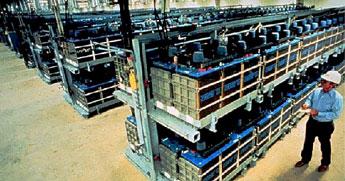
40 MWh - BIGGEST BATTERY IN THE WORLD, 1988, CHINO, NEAR LOS ANGELES, CALIFORNIA.
Load-leveling battery - reinforcement of local electricity grid network. Eight strings, each string 1032 lead-acid cells, each cell rated 3250 ampere-hours. Extra long life materials were used, including micro-porous rubber separators and special lead-antimony-arsenic positive grid and lead-calcium negative grid alloys - to give a designed cell life expectancy of 4000 and a guaranteed cycle life expectancy of 2000 deep cycles.
We designed and manufactured the automatic watering valve - stibine/ arsine trap - flame arrestor units (ASF) that were installed on this giant battery. Without these units, the battery could never have been operated.
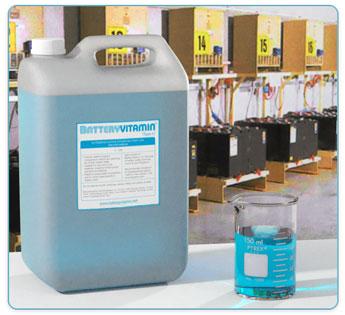
The Chino battery is seen as an important milestone, not only in terms of electricity management but in terms of battery life management. This is the catalyst that persuaded the directors of our company to invest in R&D, for a technologically sound,(and safe!), technology: Giving motive power battery users hands-on control over the life expectancy of their valuable batteries. It took twelve years. We named it Batteryvitamin.

Fleet operations, battery charging, Batteryvitamin - actuarial engineering.
Batteryvitamin L is designed to greatly slow down the wearing-out process that occurs specifically in industrial motive power batteries, (positive grid corrosion accompanied by sludging of the positive active mass, followed by loss in ampere-hours). Batteryvitamin works by physics at a nanoscale level, (explained in detail, in plain language on other pages). Batteryvitamin typically adds 40% to the service life of hard working industrial motive power batteries. One part of Batteryvitamin concentrate in 125 parts battery refill water. New and in-use batteries.
Why do motive power batteries deliver only about 1500 deep cycles, yet load leveling batteries seem to be able go on and on for 4000 deep cycles? There does not appear to be that much difference in their design and construction. Nevertheless, they are not identical. The separators preferred by knowledgeable battery operators for load leveling batteries possess a unique property - known in the trade as an ability to reduce antimony poisoning of the negative plates.
We investigated this in some considerable detail, using a variety of solvent extraction techniques to isolate the material contained in the antimony inhibiting separators. This has obviously been done many times before. Therefore, instead of the usual chemical analysis, we tried a different approach. The antimony that was poisoning the negatives had migrated there from the positives, so we reasoned that we should be looking at battery cells as electroplating cells - albeit very, very inefficient electroplating cells. After that, everything fell into place. We knew that additives in electroplating baths migrate to and are adsorbed onto the negatives. We analyzed the material's physical properties and synthesized an equivalent material with the same physical properties, although not chemically related. Finally, we developed an improved version, superior in every way to the material we had isolated, able to cut down grid corrosion to a bare minimum.
Lead-acid battery users perceive batteries as commodities, battery manufacturers perceive their market as saturated. Therefore, for argument's sake, if batteries are made to last twice as long, only half the original quantity is likely to be sold. Whether right or wrong, it does create a climate that impresses on every person with realistic expectations of a lasting career in the battery industry never to become involved in anything that can make batteries last longer. This is the long and the short of why our company is promoting this technology and battery manufacturers are not.
- FEATURES
- controls gassing;
- reduces stand self-discharge;
- protects the positives against corrosion;
- improves battery life expectancy 40 - 60 percent.
On average 2 out of every 3 lead-acid batteries that go into service are replacements for worn out batteries. We explain step-by-step:
- Why even the best made, best maintained lead-acid batteries wear out and;
- What can be done about it, (see Technical Information).
- How our Batteryvitamin technology can assist you to minimize this money eating problem, (below).

WINDOWS TO REALITY.
Motive power batteries can be considered as ampere-hour "fuel" containers. Battery users acquire these ampere-hours commercially by: (1) purchasing, (2) leasing or (3) renting the batteries. Batteryvitamin L adds a previously unsuspected extremely valuable extra dimension to battery commerce, (4) life-plus servicing: Treating batteries while they work, to make available for reuse an estimated 40% of the capital already invested in batteries - opening up superb savings opportunities for battery operators and outstanding business opportunities for battery service specialists.
Making batteries last longer is highly unlikely to cause a decrease in battery sales. Improvements in forklift trucks, including the introduction of AC drive technology, have already brought electric forklifts from well behind IC engined forklifts, to matching IC numbers in use today. Reduction in operating costs being the prime motivator. This example shows that extending battery life is virtually certain to accelerate the switchover from IC to electric, thereby increasing battery sales.
Applying remedies to batteries that have collapsed is like watering plants after they have withered and died. The rational mind knows batteries must still be in their prime to be able to benefit from treatment.
The belief that sulfation is something that inevitably happens and sets a limit on the useful life of lead-acid batteries is widespread but without technical foundation. The simple fact that lead-acid batteries on standby duty normally last many decades free of sulfation, (Brit. "sulphation"), is convincing proof sulfation is not an age related problem. Sulfation occurs when lead-acid batteries are incorrectly operated. The expression "sulfation is the leading cause of battery failure" is marketing-speak. It is, in fact, corrosion that sets the ultimate upper limit on battery life.
Nothing has yet been shown to work on hard sulfate and worn out batteries - but certain types of pulse charging are believed to be effective as an applied precaution against automotive, truck, marine, aviation battery sulfation. (Pulse charging and Batteryvitamin appear to be compatible technologies.)
- Batteryvitamin L is the only available form of user-applied treatment effective against motive power battery corrosion.
- Batteryvitamin S is surprisingly effective at reducing automotive, truck, marine, aviation battery stand self-discharge.
According to reliable industry sources, the total value of lead-acid automobile batteries in use worldwide in 2010 was $ 57 billion - lead-acid motive power batteries was $11 billion.
Available: Technical assistance for evaluation of Batteryvitamin. We do not charge for this work. Confidentiality. We are committed to appoint exclusive distributors.
DETAILED TECHNICAL INFORMATION
Contact John Fetter, johnfetter@batteryvitamin.net.